
CMA US · Part 2
CMA US Part 2: Strategic Financial Management
Part 2 coaching costs ₹30,000: recorded lectures, live doubt sessions and the Success Portal, starting any time. The exam is 4 hours: 100 multiple-choice questions plus two case-based questions. IMA fees are paid separately, and individual students pay no GST.
CMA US Part 2: full course
₹30,000one part
- 50+ hours of lectures, 3,500+ practice questions, 600+ flash cards.
- Recorded lectures on laptop, PC, Android, iPhone and iPad
- Watch each lecture up to 5× its length; 1 year of access, extended free until you pass, on request
- Digital class notes and soft-copy study material (PDF, via Google Drive)
- Doubt support on Telegram and WhatsApp, plus the Part 2 Telegram group
- Taught by a qualified CMA
Taking both parts? The Success Package is ₹50,000.
Exam at a glance
How the Part 2 exam works
| CMA US Part 2 | |
|---|---|
| Exam length | 4 hours |
| Multiple-choice section | 100 questions in 3 hours, 75% of the score |
| Case-based section | 2 case-based questions in 1 hour, 25% of the score (replaced essays from May–June 2026) |
| To reach the case-based section | At least 50% on the multiple-choice questions |
| Pass mark | 360 out of 500 |
| Testing windows | January–February, May–June, September–October |
| IMA exam fee | $545 professional · $407 student |
| Study time IMA suggests | 150–170 hours |
| Our recorded course | 137 lectures in 26 chapters, about 51 hours |
Details of the new format: CMA exam changes 2026 · Book a window: CMA US exam dates · All IMA fees: CMA US fees
Syllabus
What Part 2 covers
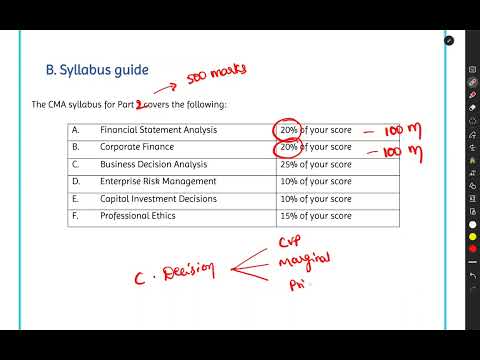
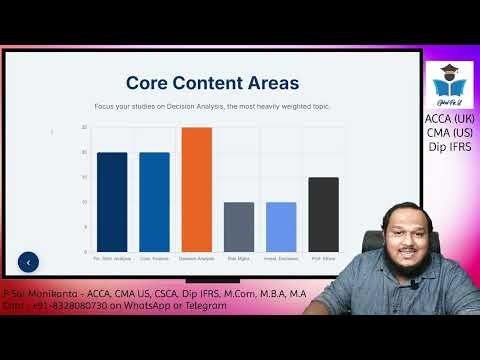
CMA Part 2: Strategic Financial Management develops the advanced analytical and decision-making capabilities expected of a senior finance professional. It moves from interpreting financial statements through ratio and profitability analysis to the complex world of corporate finance—valuation, capital structure, derivatives, and mergers. The paper then addresses the practical judgement skills that distinguish great CFOs: pricing strategy, enterprise risk management, capital budgeting under uncertainty, and the ethical responsibilities that underpin every professional decision.
| Section | Topic | Exam weight |
|---|---|---|
| A | Financial Statement Analysis | 20% |
| B | Corporate Finance | 20% |
| C | Decision Analysis | 25% |
| D | Risk Management | 10% |
| E | Investment Decisions | 10% |
| F | Professional Ethics | 15% |
Section A: Financial Statement Analysis
20% of the examFocuses on basic financial statement analysis, financial ratios, profitability analysis, and special issues.
- Comparative Financial Statement Analysis
- Financial Ratios
- Profitability Analysis
- Special Issues
Learning outcome statements (19)
- Prepare and analyze common-size financial statements (vertical analysis)
- Prepare a comparative financial statement horizontal analysis (trend analysis)
- Calculate the growth rate of individual line items
- Analyze financial statement data to identify patterns and trends
- Calculate and interpret liquidity ratios (current, quick, cash, cash flow)
- Calculate and interpret leverage ratios (debt-to-equity, debt-to-total assets, financial leverage)
- Calculate and interpret activity ratios (accounts receivable turnover, inventory turnover, accounts payable turnover, asset turnover)
- Calculate and interpret profitability ratios (gross profit margin, operating profit margin, net profit margin, ROA, ROE)
- Calculate and interpret market ratios (market/book, price/earnings, EPS, dividend yield)
- Identify the limitations of ratio analysis
- Demonstrate an understanding of the factors that contribute to inconsistent definitions of "equity," "assets,” and “return” when using ROA and ROE
- Analyze cost of sales by calculating and interpreting the gross profit margin
- Distinguish between gross profit margin, operating profit margin, and net profit margin
- Define and perform a variation analysis (percentage change over time)
- Calculate and interpret sustainable equity growth
- Demonstrate an understanding of the impact of foreign exchange rate changes on financial statements
- Demonstrate an understanding of the impact of inflation on financial ratios
- Distinguish between book value and market value, and between accounting profit and economic profit
- Identify the determinants and indicators of earnings quality
Section B: Corporate Finance
20% of the examIncludes risk and return, long-term financial management, raising capital, and working capital management.
- Financial Risk and Return
- Long-Term Financial Management
- Raising Capital
- Working Capital Management
- Corporate Restructuring
- International Finance
Learning outcome statements (25)
- Calculate rates of return
- Identify and demonstrate an understanding of systematic (market) risk and unsystematic (company) risk
- Identify and demonstrate an understanding of credit risk, foreign exchange risk, interest rate risk, and market risk
- Demonstrate an understanding of the Capital Asset Pricing Model (CAPM) and calculate expected risk-adjusted returns
- Describe the term structure of interest rates
- Define and identify the characteristics of common stock and preferred stock
- Identify and describe the basic features of a bond
- Value bonds, common stock, and preferred stock using discounted cash flow methods
- Define and demonstrate an understanding of derivatives and their uses (futures, forwards, options, swaps)
- Determine weighted average cost of capital (WACC) and the cost of its individual components
- Use the constant growth dividend discount model to value stock
- Demonstrate an understanding of the concept of market efficiency (strong, semi-strong, weak form)
- Describe lease financing and explain its advantages and disadvantages
- Define the different types of dividends (cash, stock, stock splits)
- Identify the advantages and disadvantages of debt financing vs. equity financing
- Define working capital and identify its components
- Identify and describe factors influencing the levels of cash
- Identify and explain the factors involved in determining an optimal credit policy
- Identify and calculate the costs related to inventory (carrying, ordering, stockout)
- Demonstrate an understanding of economic order quantity (EOQ)
- Identify and describe the different types of short-term credit
- Demonstrate an understanding of mergers and acquisitions, and leveraged buyouts
- Identify and describe defenses against takeovers
- Demonstrate an understanding of foreign currencies and how they affect prices of goods and services
- Demonstrate how currency futures, currency swaps, and currency options can be used to manage exchange rate risk
Section C: Decision Analysis
25% of the examDeals with cost/volume/profit (CVP) analysis, marginal analysis, and pricing decisions.
- Cost/Volume/Profit (CVP) Analysis
- Marginal Analysis
- Pricing
Learning outcome statements (23)
- Demonstrate an understanding of how cost/volume/profit (CVP) analysis is used to examine the behavior of revenues, costs, and operating income
- Calculate operating income at different operating levels
- Differentiate between fixed and variable costs
- Calculate contribution margin per unit and total contribution margin
- Calculate the breakeven point in units and dollar sales
- Demonstrate an understanding of how changes in unit sales mix affect operating income
- Define, calculate, and interpret the margin of safety
- Explain how sensitivity analysis can be used in CVP analysis
- Identify and define relevant costs (incremental, marginal), sunk costs, avoidable costs, and opportunity costs
- Explain why sunk costs are not relevant in the decision-making process
- Demonstrate proficiency in the use of marginal analysis for decisions
- Calculate the effect on operating income of a decision to accept or reject a special order
- Identify and describe qualitative factors in make-or-buy decisions
- Calculate the effect on operating income of a make-or-buy decision
- Calculate the effects on operating income of a decision to sell or process further or to drop or add a segment
- Recommend a course of action using marginal analysis
- Identify different pricing methodologies, including market comparables, cost-based, and value-based approaches
- Calculate selling price using a cost-based approach
- Demonstrate an understanding of how a company’s pricing is affected by demand, supply, and market structure
- Define and demonstrate an understanding of target pricing and target costing
- Calculate the price elasticity of demand using the midpoint formula
- Define and explain elastic and inelastic demand
- Define product life cycle and explain why pricing decisions might differ over the life of a product
Section D: Risk Management
10% of the examCovers enterprise risk management (ERM).
- Enterprise Risk
Learning outcome statements (10)
- Identify and explain the different types of risk, including business risk, hazard risk, financial risk, operational risk, and strategic risk
- Define the concepts of unexpected loss and maximum possible loss
- Identify strategies for risk response (avoid, retain, reduce, transfer, exploit)
- Demonstrate an understanding of the concept of residual risk and distinguish it from inherent risk
- Identify and describe the key steps in the risk management process
- Identify and explain qualitative risk assessment tools including risk identification, risk ranking, and risk maps
- Identify and explain quantitative risk assessment tools including cash flow at risk and earnings at risk
- Define enterprise risk management (ERM), and identify and describe key objectives, components, and benefits
- Explain how ERM practices are integrated with corporate governance, risk analytics, and internal control
- Demonstrate an understanding of the COSO Enterprise Risk Management—Integrated Framework
Section E: Investment Decisions
10% of the examCovers capital budgeting process and capital investment analysis methods.
- Capital Budgeting Process
- Capital Investment Analysis Methods
Learning outcome statements (13)
- Define capital budgeting and identify the steps or stages undertaken in developing and implementing a capital budget
- Identify and calculate the relevant cash flows of a capital investment project on a pretax and after-tax basis
- Demonstrate an understanding of how income taxes affect cash flows
- Distinguish between cash flows and accounting profits
- Discuss how the effects of inflation are reflected in capital budgeting analysis
- Identify alternative approaches to dealing with risk in capital budgeting (sensitivity analysis, scenario analysis, Monte Carlo simulation)
- Demonstrate an understanding of the two main discounted cash flow (DCF) methods, NPV and IRR
- Calculate NPV and IRR
- Demonstrate an understanding of the decision criteria used in NPV and IRR analyses
- Compare NPV and IRR focusing on their relative advantages and disadvantages
- Demonstrate an understanding of the payback and discounted payback methods
- Calculate payback periods and discounted payback periods
- Define and calculate the profitability index
Section F: Professional Ethics
15% of the examCovers business ethics and ethical considerations for management accounting and financial management professionals, based on IMA’s Statement of Ethical Professional Practice.
- Business Ethics
- Ethical Considerations for Professionals
- Ethical Considerations for the Organization
Learning outcome statements (17)
- Define business ethics
- Define the concepts of fairness, integrity, due diligence, and fiduciary responsibility
- Identify and explain the different types of business fraud
- Using the IMA Statement of Ethical Professional Practice, identify and describe the four overarching ethical principles and the four standards (Competence, Confidentiality, Integrity, Credibility)
- Evaluate a given business situation for its ethical implications
- Recommend a course of action for management accounting professionals when confronted with an ethical dilemma
- Using the fraud triangle model, identify the three components (opportunity, pressure, rationalization)
- Discuss the issues organizations face in applying their values and ethical standards internationally
- Demonstrate an understanding of the relationship between ethics and internal controls
- Define corporate culture and demonstrate an understanding of its role in ethical decision making
- Demonstrate an understanding of the importance of a code of conduct
- Analyze the impact of groupthink on ethical behavior
- Demonstrate an understanding of the role of “leadership by example” or “tone at the top”
- Explain the importance of a whistleblowing framework
- Identify the purpose of anti-bribery laws, such as the U.S. Foreign Corrupt Practices Act (FCPA)
- Define and demonstrate an understanding of the major issues of sustainability and social responsibility
- Define data ethics and explain the principles of fairness, privacy, transparency, ownership, and accountability
Free
Watch a demo lecture


What's inside
Every Part 2 chapter and lecture
26 chapters, 137 recorded lectures, about 51 hours.Open a chapter to see its lectures.
Intro Lectures1 lecture · 41 min
- CMA US P2 - Intro00:40:40
Section A Financial Statement Analysis1 lecture · 13 min
- Section A Financial Statement Analysis00:12:38
A.1. Comparative Fin Statements4 lectures · 1 h 31 min
- A.1. Comparative Financial Statement Analysis00:04:52
- A.1.1 - Common Size Financial Statements00:36:57
- A.1.2 - Common Base Year Financial Statements00:21:50
- A.1.3 - Financial Trend Analysis00:26:53
A2. Financial ratios19 lectures · 5 h 40 min
- A.2. Financial Ratios - Introduction00:12:05
- A.2.1.1 - 01. Liquidity Intro00:20:48
- A.2.1.1 - 02. Ratios and problems00:28:09
- A.2.2.1 � 1. Intro to Leverage Ratios00:13:36
- A.2.2.1 � 2. Degree of Operating Leverage00:22:05
- A.2.2.1 � 3. Degree of Financial Leverage00:20:02
- A.2.2.1 � 4. Degree of Total Leverage00:06:21
- A.2.2.2 � 01. Intro to Capital Structure00:19:15
- A.2.2.2 � 02. Capital Structure Ratios00:17:00
- A.2.2.2 � 03. Coverage Ratios00:13:50
- A.2.3.1 - 1. Intro to Activity Ratios00:08:59
- A.2.3.1 - 2. Days and Turnover Ratios00:23:07
- A.2.3.1 - 3. Cycles and Asset Ratios00:09:35
- A.2.4.1 � Profitability Ratios00:27:22
- A.2.4.2 � DuPont Analysis00:07:32
- A.2.5.1 � 1. Market Ratios00:36:03
- A.2.5.1 � 2. EPS and DPS00:20:58
- A.2.5.1 � 3. Yeild Ratios00:11:54
- A.2.6.1 � General Ratio Analysis Considerations00:21:03
A3. Profitability analysis7 lectures · 1 h 52 min
- A.3.1 �Return and Profitability Concepts00:06:21
- A.3.1.1 �Recap of Return and Profitability00:19:11
- A.3.1.2 � 1. Measurement and Quality of Income00:19:43
- A.3.1.2 � 2. Revenue Relationships00:11:32
- A.3.1.3 � Analysis of Profit Margins00:06:39
- A.3.1.4 � 01. Trend and Growth Analysis00:21:29
- A.3.1.4 � 02. Sustainable Growth00:26:37
A4. Special Issues2 lectures · 45 min
- A.4.1 - 01. Forex and Inflation00:27:57
- A.4.1 - 02. Other issues00:16:52
B. Corporate Finance1 lecture · 8 min
- B. Corporate Finance - Intro00:07:44
B1. Financial risk and return8 lectures · 1 h 37 min
- B.1.1.1 - Rates of Return00:22:57
- B.1.1.2 � Risk in Finance00:09:13
- B.1.2.1 � Systematic Risk vs Unsystematic Risk00:08:58
- B.1.2.2 - Credit Risk, FX Risk, Interest Rate Risk00:11:35
- B.1.2.3 - Individual Security Risk vs. Portfolio R00:10:01
- B.1.3.1 - The Relationship Between Risk and Return00:11:00
- B.1.3.2 - Beta Definition00:09:49
- B.1.3.3 - Capital Asset Pricing Model (CAPM)00:13:45
B2. Long-term financial management15 lectures · 5 h 33 min
- B.2. Long-Term Financial Management00:11:14
- B.2.1.1 � 01. Intro00:18:47
- B.2.1.1 � 02. Advantages and Disadvantages00:17:30
- B.2.1.1 � 03. Types of Bonds00:23:40
- B.2.1.2 � 01. Components and Characteristics of a00:20:29
- B.2.1.2 � 02. Bond Ratings and Yield Curve00:15:20
- B.2.1.2 � 03. Valuation of Bond00:21:07
- B.2.1.3 � Term Structure of Interest Rates00:09:34
- B.2.1.4 � Debt Issuance and Refinancing Strategies00:07:39
- B.2.1.5 � Duration of Bond- Interest Rate Sensiti00:14:45
- B.2.2 - Stocks00:30:42
- B.2.3 - Derivatives01:22:16
- B.2.4 - Other Long Term Securities00:12:14
- B.2.5 - Cost of Capital00:23:24
- B.2.6 - Valuation of Securities00:23:55
B3. Raising capital3 lectures · 2 h 23 min
- B.3.1 - Financial Markets and Institutions01:12:48
- B.3.2 - Equity00:36:39
- B.3.3 - Debt and Leasing00:33:56
B4. Working capital management1 lecture · 2 h 25 min
- B4. Working capital management02:25:07
B5. Corporate restructuring1 lecture · 2 h 13 min
- B.5. Corporate Restructuring02:12:51
B6. International finance1 lecture · 39 min
- B.6. International Finance00:38:57
C. Business Decision Analysis1 lecture · 14 min
- 01. Introduction to Section C00:13:58
C1. Cost/volume/profit analysis10 lectures · 2 h 46 min
- C.1. Cost Volume Profit (CVP) Analysis00:07:06
- C.1.1.1 - Introduction to CVP and Cost Classificat00:19:28
- C.1.1.2 - Contribution Margin and Cost Behavior Ca00:10:41
- C.1.1.3 - Break-Even and Target Profit Analysis00:41:34
- C.1.1.4 - Sales Mix and Multi-Product CVP Analysis00:34:37
- C.1.2.1 - Margin of Safety00:12:58
- C.1.3.1 - Sensitivity Analysis in CVP Analysis00:16:31
- C.1.4.1 - CVP Analysis with Income Taxes00:12:38
- C.1.5.1 - Application of CVP Analysis00:05:10
- C.1.5.2 - Review and Recap00:04:52
C2. Marginal Analysis9 lectures · 3 h 12 min
- C.2. Marginal Analysis00:10:51
- C.2.1.1 - Cost Concepts for Decision Making00:44:44
- C.2.1.2 - Marginal Cost vs Marginal Revenue00:11:18
- C.2.2.1 - Special Order Decisions00:25:40
- C.2.2.2 - Make-or-Buy Decisions00:31:19
- C.2.3.1 - Add or Drop a Segment00:18:12
- C.2.3.2 - Sell or Process Further00:18:39
- C.2.3.3 - Capacity Constraints (Product Mix)00:16:44
- C.2.4 - Advanced Considerations00:14:22
C3. Pricing1 lecture · 2 h 14 min
- C3. Pricing02:13:50
D.1. Enterprise risk20 lectures · 6 h 26 min
- D.1. Enterprise risk00:22:46
- D.1.1.1 - Risk, Nature and Types of Risks00:38:37
- D.1.1.2 - Time and Volatility in Risk Assessment00:08:59
- D.1.2.1 - 01. Intro and Scenario00:32:40
- D.1.2.1 - 02. Capital Adequacy00:21:34
- D.1.2.2 - Expected, Unexpected, and Extreme Losses00:20:52
- D.1.2.3 - 01. Intro and Risk Identification00:13:18
- D.1.2.3 - 02. Risk Ranking00:06:52
- D.1.2.3 - 03. Risk Maps00:09:03
- D.1.2.3 - 04. Case Study00:13:01
- D.1.2.4. 01. Quantitative Risk Measures00:10:59
- D.1.2.4. 02. Value at Risk00:10:31
- D.1.3.1 - 01. Risk Response and TARA00:18:04
- D.1.3.1 - 02. Risk Transfer and Insurance00:22:43
- D.1.3.1 - 03. Inherent and Residual Risk00:07:29
- D.1.3.2 - 01. Evaluating Scenarios and Risk Strate00:12:30
- D.1.3.3 - 01. Omega Case Study00:18:44
- D.1.4.1 - Foundations of Risk Management_compress_00:36:56
- D.1.4.2 - Enterprise Risk Management (ERM) Framewo00:35:23
- D.1.4.3 - COSO Enterprise Risk Management Integrat00:24:30
E1. Capital budgeting process3 lectures · 55 min
- E1-0100:03:48
- E1-0200:27:08
- E1-0400:24:08
E2. Capital investment analysis methods3 lectures · 2 h 53 min
- E2-0100:35:14
- E2-0201:38:41
- E2-0300:39:31
Section F Professional Ethics1 lecture · 18 min
- Section F Professional Ethics00:17:59
F.1. Business Ethics8 lectures · 2 h 7 min
- F.1. Business Ethics00:02:24
- F.1.1.1 � 01. Introduction00:31:04
- F.1.1.1 � 02. Exam Tips for Business Ethics00:03:27
- F.1.1.1 � 03. Business Ethics00:14:30
- F.1.1.2 - 01. Key Ethical Concepts00:07:27
- F.1.1.2 - 02. Key Ethical Concepts00:21:53
- F.1.1.3 - 01. Fradulent Financial Reporting00:29:59
- F.1.1.3 - 02. Misappropriation of Assets00:16:42
F.2. Ethical Considerations for Finance Profession5 lectures · 1 h 7 min
- F.2. Ethical Considerations for Finance Profession00:06:45
- F.2.2.1 � 01. Overview of the Fraud Triangle Model00:17:37
- F.2.2.1 � 02. Using the Fraud Triangle00:18:01
- F.2.2.1 � 03. Red Flags and Conclusion00:09:23
- F.2.2.1 � 04. Scenarios on Fraud Triangle topic00:15:17
F2. Ethical considerations for management accounting and financial management professionals3 lectures · 50 min
- F.2.1.1 - 01. Principles and Standards00:25:28
- F.2.1.1 - 02. Approaching Ethical Scenarios00:16:34
- F.2.1.1 - 03. Conflict of Interest00:08:25
F3. Ethical considerations for the organization8 lectures · 2 h 25 min
- F.3.1 - Ethical Considerations for the Organizatio00:01:46
- F.3.1.1 - 01. Intro00:06:19
- F.3.1.1 - 02. Importance of Ethical Decision-Makin00:20:57
- F.3.1.1 - 03. Ethics in Companies00:32:27
- F.3.2.1 - Corporate Social Responsibility (CSR)00:22:09
- F.3.2.2 - Sustainability and Social Responsibility00:14:21
- F.3.3.1 - 01. Data Ethics and Protection00:26:20
- F.3.3.1 - 02. Data Ethics and Protection00:20:46
AI Tools1 lecture · 9 min
- Gamma AI - Demo00:08:56

Your tutor
Sai Manikanta Pedamallu
CMA (US), ACCA (UK), CSCA (US), Dip IFRS, AFA (UK), MIPA (Aus), M.Com, M.B.A
- Qualified CMA who teaches: CMA (US), ACCA (UK), CSCA (US), Dip IFRS and three master's degrees (M.Com, MBA, M.A.).
- First CSCA from IMA's Hyderabad chapter: the first person there to earn IMA's Certified in Strategy and Competitive Analysis.
- 13+ years in practice: accounts, taxation and audit (internal, bank, statutory and tax audits), and now ERP product management and finance control.
- Rated by students: 9.5/10 satisfaction, based on student feedback collected across batches over 12+ years.
No GST for individual students. Need a GST invoice for input credit? Ask us — 18% GST is added. Manual UPI has no extra charge; cards and net banking through Razorpay add 2% + GST (2.36%).
Questions about Part 2?
Tell us your background and target window. We will tell you which part to start with and how long it realistically takes.