
CMA US · Part 1
CMA US Part 1: Financial Planning, Performance, and Analytics
Part 1 coaching costs ₹30,000: recorded lectures, live doubt sessions and the Success Portal, starting any time. The exam is 4 hours: 100 multiple-choice questions plus two case-based questions. IMA fees are paid separately, and individual students pay no GST.
CMA US Part 1: full course
₹30,000one part
- 110+ hours of lectures, 4,700+ practice questions, 1,350+ flash cards.
- Recorded lectures on laptop, PC, Android, iPhone and iPad
- Watch each lecture up to 5× its length; 1 year of access, extended free until you pass, on request
- Digital class notes and soft-copy study material (PDF, via Google Drive)
- Doubt support on Telegram and WhatsApp, plus the Part 1 Telegram group
- Taught by a qualified CMA
Taking both parts? The Success Package is ₹50,000.
Exam at a glance
How the Part 1 exam works
| CMA US Part 1 | |
|---|---|
| Exam length | 4 hours |
| Multiple-choice section | 100 questions in 3 hours, 75% of the score |
| Case-based section | 2 case-based questions in 1 hour, 25% of the score (replaced essays from May–June 2026) |
| To reach the case-based section | At least 50% on the multiple-choice questions |
| Pass mark | 360 out of 500 |
| Testing windows | January–February, May–June, September–October |
| IMA exam fee | $545 professional · $407 student |
| Study time IMA suggests | 150–170 hours |
| Our recorded course | 381 lectures in 31 chapters, about 112 hours |
Details of the new format: CMA exam changes 2026 · Book a window: CMA US exam dates · All IMA fees: CMA US fees
Syllabus
What Part 1 covers
CMA Part 1: Financial Planning, Performance and Analytics builds the management accounting competencies that underpin every business decision. It covers the full spectrum of financial reporting under GAAP and IFRS, the design of strategic plans and budgets, performance evaluation of responsibility centres, cost management from job-order costing to activity-based methods, and the governance and control frameworks that protect an organisation. The final section reflects the modern finance function: how data analytics, ERP systems, and emerging technologies are reshaping the role of the management accountant.
| Section | Topic | Exam weight |
|---|---|---|
| A | External Financial Reporting Decisions | 15% |
| B | Planning, Budgeting, and Forecasting | 20% |
| C | Performance Management | 20% |
| D | Cost Management | 15% |
| E | Internal Controls | 15% |
| F | Technology and Analytics | 15% |
Section A: External Financial Reporting Decisions
15% of the examCovers financial statements, consolidation, integrated reporting, recognition, measurement, valuation, equity, revenue, and GAAP/IFRS differences.
- Financial Statements
- Recognition, Measurement, and Valuation
- Equity Transactions
- Revenue Recognition
- Income Measurement
- GAAP-IFRS Differences
Learning outcome statements (48)
- Identify the users of financial statements and their needs
- Demonstrate an understanding of the purposes and uses of each statement
- Identify the major components and classifications of each statement
- Identify the limitations of each financial statement
- Identify how various financial transactions affect the elements of each of the financial statements and determine the proper classification of a given transaction
- Demonstrate an understanding of the relationship among the financial statements
- Demonstrate an understanding of how a balance sheet, an income statement, a statement of changes in equity, and a statement of cash flows (indirect method) are prepared
- Define consolidated financial statements
- Define the two types of consolidation models: variable interest entity model and voting interest model
- Demonstrate an understanding of the three types of consolidation accounting: full consolidation, proportionate consolidation, and equity consolidation
- Demonstrate an understanding of intracompany balances and transactions that should be eliminated in consolidation
- Define integrated reporting, integrated thinking, and the integrated report, and demonstrate an understanding of the relationship among them
- Identify the primary purpose of integrated reporting
- Explain the fundamental concepts of value creation, the six capitals, and the value creation process
- Identify elements of an integrated report
- Identify and explain the benefits and challenges of adopting integrated reporting
- Identify issues related to the valuation of accounts receivable
- Distinguish between receivables sold (factoring) on a with-recourse basis and those sold on a without-recourse basis
- Identify issues in inventory valuation, including which goods to include, what costs to include, and which cost assumption to use
- Identify and compare cost flow assumptions used in accounting for inventories
- Demonstrate an understanding of the lower of cost or market rule for LIFO and the retail inventory method, and the lower of cost and net realizable value rule for all other inventory methods
- Calculate the effect on income and on assets of using different inventory methods
- Analyze the effects of inventory errors
- Identify advantages and disadvantages of the different inventory methods
- Recommend the inventory method and cost flow assumption that should be used for a company given a set of facts
- Demonstrate an understanding of the following debt security types: trading, available-for-sale, and held-to-maturity
- Demonstrate an understanding of the valuation of debt and equity securities
- Determine the effect on the financial statements of using different depreciation methods
- Recommend a depreciation method for a given set of data
- Demonstrate an understanding of the accounting for impairment of long-term assets and intangible assets, including goodwill
- Identify the classification issues of short-term debt expected to be refinanced
- Compare the effect on financial statements when using either the assurance warranty approach or the service warranty approach for accounting for warranties
- Demonstrate an understanding of interperiod tax allocation/deferred income taxes
- Distinguish between deferred tax liabilities and deferred tax assets
- Differentiate between temporary differences and permanent differences, and identify examples of each
- Distinguish between operating and finance leases
- Recognize the correct financial statement presentation of operating and finance leases
- Identify transactions that affect paid-in capital and those that affect retained earnings
- Determine the effect on shareholders’ equity of large and small stock dividends, and stock splits
- Apply revenue recognition principles to various types of transactions
- Demonstrate an understanding of revenue recognition for contracts with customers using the steps required to recognize revenue
- Demonstrate an understanding of the matching principle with respect to revenues and expenses, and be able to apply it to a specific situation
- Define gains and losses, and indicate the proper financial statement presentation for gains and losses
- Demonstrate an understanding of the treatment of gain or loss on the disposal of fixed assets
- Demonstrate an understanding of expense recognition practices
- Define and calculate comprehensive income
- Identify the correct treatment of discontinued operations
- Identify and describe the differences between U.S. GAAP and IFRS regarding expense recognition, intangible assets, inventories, leases, long-lived assets, and impairment of assets
Section B: Planning, Budgeting, and Forecasting
20% of the examIncludes strategic planning, budgeting concepts, forecasting techniques, and top-level planning and analysis.
- Strategic Planning
- Budgeting Concepts
- Forecasting Techniques
- Budget Methodologies
- Annual Profit Plan and Supporting Schedules
- Top-Level Planning and Analysis
Learning outcome statements (36)
- Discuss how strategic planning determines the path an organization chooses for attaining its long-term goals, vision, and mission
- Identify the time frame appropriate for a strategic plan
- Identify the external and internal factors that should be analyzed during the strategic planning process
- Demonstrate an understanding of how an organization’s mission leads to the formulation of long-term business objectives
- Explain why short-term objectives, tactics, and operational planning must be congruent with the strategic plan
- Identify the characteristics of successful strategic plans
- Describe Porter’s generic strategies, including cost leadership, differentiation, and focus
- Demonstrate an understanding of planning tools and techniques like SWOT analysis, Porter’s Five forces, PEST analysis, and BCG Growth-Share Matrix
- Describe the role that budgeting plays in the overall planning and performance evaluation process of an organization
- Explain the interrelationships between economic conditions, industry situation, and an organization’s plans and budgets
- Identify the characteristics that define successful budgeting processes
- Explain how the budgeting process facilitates communication and enhances coordination
- Describe the concept of a controllable cost as it relates to both budgeting and performance evaluation
- Differentiate between ideal (theoretical) standards and currently attainable (practical) standards
- Differentiate between authoritative standards and participative standards
- Identify the steps to be taken in developing standards for both direct material and direct labor
- Discuss the importance of a policy that allows budget revisions
- Explain the role of budgets in monitoring and controlling expenditures
- Define budgetary slack and discuss its impact on goal congruence
- Demonstrate an understanding of a simple regression equation
- Define a multiple regression equation
- Calculate the result of a simple regression equation
- Demonstrate an understanding of learning curve analysis
- Calculate the results under a cumulative average-time learning model
- Identify the benefits and shortcomings of regression analysis and learning curve analysis
- Calculate the expected value of random variables
- Identify the benefits and shortcomings of the expected value technique
- Use probability values to estimate future cash flows
- For each of the budget systems (annual/master, project, activity-based, zero-based, continuous, flexible), define its purpose, use, time frame, and components
- Evaluate a business situation and recommend an appropriate budget solution
- Explain the role of the sales budget in the development of an annual profit plan
- Prepare a production budget, direct materials budget, direct labor budget, overhead budget, cost of goods sold budget, and cash budget
- Demonstrate an understanding of contribution margin and its use
- Define the purpose of a pro forma income statement, balance sheet, and statement of cash flows
- Use financial projections to prepare pro forma statements
- Use financial projections to determine required outside financing and dividend policy
Section C: Performance Management
20% of the examFocuses on cost and variance measures, responsibility centers and reporting segments, and performance measures.
- Cost and Variance Measures
- Responsibility Centers and Reporting Segments
- Performance Measures
Learning outcome statements (29)
- Analyze performance against operational goals using measures based on revenue and costs
- Prepare a performance analysis by comparing actual results to the master budget and calculate variances
- Identify and describe the benefits and limitations of measuring performance by comparing actual results to the master budget
- Analyze a flexible budget based on actual sales (output) volume
- Calculate the sales-volume variance and the sales-price variance
- Calculate the flexible-budget variance
- Investigate the flexible-budget variance to determine individual differences between actual and budgeted input prices and quantities
- Define a standard costing system
- Demonstrate an understanding of price (rate) variances and efficiency (usage) variances for direct material and direct labor
- Demonstrate an understanding of spending and efficiency variances as they relate to fixed and variable overhead
- Calculate a sales-mix variance and explain its impact
- Analyze factory overhead variances
- Analyze variances, identify causes, and recommend corrective actions
- Identify and explain the different types of responsibility centers
- Calculate a contribution margin
- Analyze a contribution margin report and evaluate performance
- Identify segments that organizations evaluate, including product lines, geographical areas, or other meaningful segments
- Explain why the allocation of common costs among segments can be an issue
- Define transfer pricing and identify its objectives
- Identify the methods for determining transfer prices (variable cost, full cost, market price, negotiated price)
- Explain why performance evaluation measures should be directly related to strategic and operational goals
- Explain the issues involved in determining product profitability, business unit profitability, and customer profitability
- Calculate product-line profitability, business unit profitability, and customer profitability
- Define and calculate ROI
- Define and calculate residual income (RI)
- Compare the benefits and limitations of ROI and RI as measures of performance
- Define critical success factors (CSFs) and KPIs
- Define the concept of a balanced scorecard and identify its components (financial, customer, internal process, learning and growth)
- Demonstrate an understanding of a strategy map and the role it plays
Section D: Cost Management
15% of the examDeals with measurement concepts, costing systems, overhead costs, and supply chain management.
- Measurement Concepts
- Costing Systems
- Overhead Costs
- Supply Chain Management
- Business Process Improvement
Learning outcome statements (27)
- Calculate fixed, variable, and mixed costs
- Identify cost objects and cost pools, and assign costs to appropriate activities
- Demonstrate an understanding of the nature and types of cost drivers
- Identify and define cost measurement techniques, such as actual costing, normal costing, and standard costing
- Demonstrate an understanding of variable (direct) costing and absorption (full) costing
- Calculate inventory costs, cost of goods sold, and operating profit using both variable costing and absorption costing
- Determine the appropriate use of joint product and by-product costing
- Determine the allocation of joint product and by-product costs using various methods
- For job order costing and activity-based costing, define the nature of the system, understand the cost flows, and identify its appropriate use
- Calculate product cost using an activity-based system, and compare and analyze the results with costs calculated using a traditional system
- Demonstrate an understanding of the concept of life-cycle costing
- Distinguish between fixed and variable overhead expenses
- Demonstrate an understanding of the different methods of determining overhead rates (e.g., corporate-wide rates, departmental rates)
- Calculate overhead expense in an activity-based costing setting
- Identify and describe the benefits derived from activity-based overhead allocation
- Calculate service or support department cost allocations using the direct method, the step-down method, and the dual allocation method
- Explain supply chain management
- Define lean resource management techniques
- Identify and describe the operational benefits of implementing a just-in-time (JIT) system and ERP
- Explain the concept of outsourcing and identify its benefits and limitations
- Describe how capacity level affects product costing, capacity management, pricing decisions, and financial statements
- Define value chain analysis and explain how it is used to better understand a company’s competitive advantage
- Define, identify, and provide examples of a value-added activity
- Demonstrate an understanding of process analysis and business process reengineering
- Demonstrate an understanding of benchmarking process performance
- Explain the concept of continuous improvement and how it relates to implementing ideal standards and quality improvements
- Identify and describe the components of the costs of quality (prevention, appraisal, internal failure, external failure)
Section E: Internal Controls
15% of the examCovers governance, risk, and compliance, systems controls, and security measures.
- Governance, Risk, and Compliance
- System Controls and Security Measures
Learning outcome statements (26)
- Demonstrate an understanding of internal control risk and its management
- Identify and describe internal control objectives
- Identify the Board of Directors’ responsibilities
- Demonstrate an understanding of corporate governance, including rights and responsibilities of the CEO, CFO, Board of Directors, audit committee, and other stakeholders
- Describe how internal controls provide reasonable assurance regarding objectives involving operations, reporting, and compliance
- Define and give examples of segregation of duties
- Define inherent risk, control risk, and detection risk
- Define and distinguish between preventive controls and detective controls
- Describe the major internal control provisions of the Sarbanes-Oxley Act
- Identify the role of the Public Company Accounting Oversight Board (PCAOB)
- Identify and describe the major internal control provisions of the Foreign Corrupt Practices Act
- Identify and describe the five major components of COSO’s Internal Control—Integrated Framework
- Assess the level of internal control risk within an organization and recommend risk mitigation strategies
- Demonstrate an understanding of external auditor responsibilities
- Describe how the segregation of accounting duties can enhance systems security
- Identify threats to information systems (e.g., input manipulation, program alteration, data theft, viruses)
- Demonstrate an understanding of how system development controls are used to enhance accuracy, validity, safety, and security
- Identify procedures to limit access to physical hardware
- Identify input controls, processing controls, and output controls
- Identify and describe the types of storage controls
- Define data encryption and describe why it is needed
- Identify a firewall and its uses
- Demonstrate an understanding of how flowcharts of activities are used to assess controls
- Explain the importance of backing up all program and data files regularly
- Define business continuity planning
- Define the objective of a disaster recovery plan and identify its components (hot, warm, and cold sites)
Section F: Technology and Analytics
15% of the examEncompasses information systems, data governance, technology-enabled finance transformation, and data analytics.
- Information Systems
- Data Governance
- Technology-Enabled Finance Transformation
- Data Analytics
Learning outcome statements (27)
- Identify the role of the accounting information system (AIS) in the value chain
- Demonstrate an understanding of the accounting information system cycles (revenue to cash, expenditures, production, HR, etc.)
- Define ERP and identify and explain its advantages and disadvantages
- Define relational database and demonstrate an understanding of a database management system
- Define data warehouse and data mart
- Define enterprise performance management (EPM)
- Define data governance and data management
- Identify the stages of the data life cycle (data capture, maintenance, synthesis, usage, etc.)
- Demonstrate an understanding of data preprocessing and the steps to convert data for further analysis
- Discuss the importance of having a documented record retention policy
- Identify and explain controls and tools to detect and thwart cyberattacks
- Define the system development life cycle (systems analysis, conceptual design, physical design, implementation, maintenance)
- Define robotic process automation (RPA) and its benefits
- Evaluate where technologies can improve efficiency and effectiveness of processing accounting data (e.g., artificial intelligence (AI))
- Define cloud computing and describe how it can improve efficiency
- Define software-as-a-service (SaaS) and explain its advantages and disadvantages
- Recognize potential applications of blockchain, distributed ledger, and smart contracts
- Define Big Data and explain the volume, velocity, variety, and veracity of Big Data
- Explain how structured, semi-structured, and unstructured data is used
- Describe the progression of data, from data to information to knowledge to insight to action
- Define business intelligence (BI)
- Define data mining and describe its challenges
- Define the different types of data analytics, including descriptive, diagnostic, predictive, and prescriptive
- Demonstrate an understanding of multiple regression, logistic regression, and time series analyses
- Utilize table and graph design best practices to avoid distortion
- Evaluate data visualization options and select the best presentation approach (e.g., histograms, dashboards, bar charts)
- Communicate results, conclusions, and recommendations in an impactful manner using effective visualization techniques
Free
Watch a demo lecture



What's inside
Every Part 1 chapter and lecture
31 chapters, 381 recorded lectures, about 112 hours.Open a chapter to see its lectures.
1. CMA Course Details2 lectures · 1 h 30 min
- 01. CMA US Important Resources01:06:43
- 02. Complete Details about CMA Syllabus changes 2000:22:51
2. CMA Part 1 Details2 lectures · 23 min
- 01. CMA US Part 1 Exam Guide- Structure, Pass Perc00:13:58
- 02. Mastering CMA US Part 1 - A Comprehensive Syll00:09:31
A. Sec A - Intros3 lectures · 51 min
- 01. Sec A - External Financial Reporting Decisions00:16:14
- 01. Section A External Financial Reporting Decisio00:24:25
- 02. Sec A - IMP Topics00:10:50
A1. Financial Statements23 lectures · 9 h 32 min
- A1. Financial Statements00:07:55
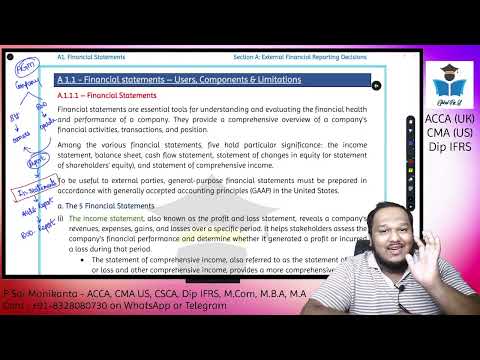
- A.1.1.1 – 1. Intro to FS00:11:55
- A.1.1.1 – 2. 5 Financial Statements00:28:46
- A.1.1.1 – 3. Misc00:11:26
- A.1.1.2 - Users of financial statements00:09:06
- A.1.1.3 - 1. Income Statement00:41:15
- A.1.1.3 - 2. Balance Sheet00:41:50
- A.1.1.3 - 3. Cash Flow Statement00:54:28
- A.1.1.3 - 4. St of Changes in Equity00:49:31
- A.1.1.3 - 5. Notes to Accounts00:20:23
- A.1.1.4 - Connections in FS00:07:17
- A.1.2.1 - Consolidated FS00:51:06
- A.1.2.2 - 1. Three Types of Consolidations00:27:05
- A.1.2.2 - 2. Example00:09:34
- A.1.2.3 – 1. Acquisition Method00:21:02
- A.1.2.3 – 2. Goodwill00:18:19
- A.1.2.3 – 3. Consol at Aquisition00:37:33
- A.1.2.3 – 4. Post Acq and Adjustments00:46:57
- A.1.3.1 – Introduction 00:11:55
- A.1.3.2 - Purpose of Integrated Reporting00:07:27
- A.1.3.3 - Fundamental Concepts of Value Creation00:17:43
- A.1.3.4 - Elements of an Integrated Report00:09:50
- A.1.3.5 - Benefits and challenges00:12:58
A1. Financial Statements - Revision3 lectures · 5 h 7 min
- P1-A1-Revision-101:37:56
- P1-A1-Revision-201:07:14
- P1-A1-Revision-302:21:36
A2. Recognition, measurement, and valuation84 lectures · 20 h 51 min
- A.2.1.1 - 1. Intro to AR00:10:09
- A.2.1.1 - 2. Measurement00:06:50
- A.2.1.1 - 3. Discounts00:32:31
- A.2.1.1 - 4. Allowance for Bad Debts00:33:23
- A.2.1.1 - 5. Accounting Entries00:12:44
- A.2.1.1 - 6. Factoring00:21:58
- A.2.1.2 – 1. Inventory00:13:11
- A.2.1.2 – 2. Special Items of Inventory00:20:14
- A.2.1.2 – 3. Periodic vs Perpetual Systems00:19:06
- A.2.1.2 – 4. Cost Flow Assumptions00:17:47
- A.2.1.2 – 5. FI-FO00:21:22
- A.2.1.2 – 6. Weighted Avg00:36:54
- A.2.1.2 – 7. LIFO Basics00:18:58
- A.2.1.2 – 8. LIFO Periodic and Perpetual00:22:53
- A.2.1.2 – 9. Summary of all Methods00:06:31
- A.2.1.2 – 10. Comprehensive Problem00:36:04
- A.2.1.2 – 11. Valuation of Inventory00:24:06
- A.2.1.2 – 12. Cost, NRV and Maket00:28:08
- A.2.1.2 – 13. Invetory Errors00:24:59
- A.2.1.2 – 14. US GAAP vs IFRS00:02:16
- A 2.2 - Non-Current Assets valuation00:06:50
- A.2.2.1 - 1. Property, Plant, and Equipment00:05:29
- A.2.2.1 - 2. Initial Measurement00:12:23
- A.2.2.1 - 3. Borrowing Costs00:40:30
- A.2.2.1 - 4. Subsequent Measurement00:09:47
- A.2.2.1 - 5. Capital vs. Revenue Expenditures00:07:12
- A.2.2.1 - 6. Depreciation - Basics00:23:52
- A.2.2.1 - 7. Depreciation Methods00:31:29
- A.2.2.1 - 8. Summary and Problem00:24:35
- A.2.2.2 - 1. Intro to Intangible Assets00:13:31
- A.2.2.2 - 2. Accounting Intangible Assets00:20:09
- A.2.2.2 - 3. Specific Intangible Assets00:20:29
- A.2.2.3 – 1. Impairment Intro00:06:35
- A.2.2.3 – 2. Impairment Calculation00:15:58
- A.2.2.3 – 3. IFRS Impairment and Problem00:16:00
- A.2.2.3 – 4. Indefinite Life assets00:09:12
- A.2.2.3 – 5. Goodwill Impairment00:20:13
- A.2.2.4 - 1. Investments in Debt Securities00:13:27
- A.2.2.4 - 2. Classification of Debt Sec00:19:05
- A.2.2.4 - 3. Valuation of Debt Sec00:19:47
- A.2.2.4 - 4. HTM Amortized Cost Model00:21:21
- A.2.2.4 - 5. Impairment of Debt Sec00:31:16
- A.2.2.5 - 1. Equity Securities00:06:33
- A.2.2.5 - 2. Classification00:08:29
- A.2.2.5 - 3. Valuation00:08:08
- A.2.2.5 - 4. Impairment00:05:13
- A.2.2.5 - 5. Sale of Equity and Problem00:19:59
- A.2.2.5 - 6. Equity Method00:08:49
- A.2.2.5 - 7. Summary00:06:32
- A.2.3.1 – 1. Liabilities00:08:22
- A.2.3.1 – 2. Trade Accounts Payable00:27:20
- A.2.3.1 – 3. Contingencies00:18:12
- A.2.3.1 – 4. Warranties00:20:16
- A.2.3.2 - 1. Leases Intro00:14:00
- A.2.3.2 - 2. Classification Test00:11:03
- A.2.3.2 - 3. Initial Recognition00:24:20
- A.2.3.2 - 4. Subsequent Finance Leases00:25:35
- A.2.3.2 - 5. Finance Leases Problem00:23:31
- A.2.3.2 - 6. Operating Leases00:24:11
- A.2.3.2 - 7. Short Term Leases00:03:29
- A.2.3.3 - 1. Income taxes00:22:08
- A.2.3.3 - 2. Tax Allocation00:07:19
- A.2.3.3 - 3. Temporary and Permanent Differences00:12:43
- A.2.3.3 - 4. Deferred Taxes00:35:41
- A.2.3.4 - 1. Bonds Payables00:13:09
- A.2.3.4 - 2. Bond Issuance00:27:45
- A.2.3.4 - 3. Amortization of Premium or Discount00:17:28
- A.2.3.4 - 4. Journal Entries00:21:11
- A 2.4 - Revenue recognition - Intro00:03:35
- A.2.4.1 - Revenue from Contracts with Customers01:14:17
- A.2.4.2 - 1. Recognition of Revenue over Time00:38:18
- A.2.4.2 - 2. Practice Problem00:07:47
- A.2.4.2 - 3. Recap and Problem00:13:45
- A.2.4.2 - 4. Netting Off00:06:46
- A.2.4.3 - Matching Principle00:06:37
- A.2.5.1 – 1. Issuance of Stock00:13:24
- A.2.5.1 – 2. Treasury Stock00:16:38
- A.2.5.1 – 3. Cash Dividend00:05:25
- A.2.5.1 – 4. Property Dividend00:04:00
- A.2.5.1 – 5. Stock Dividends00:09:53
- A.2.5.1 – 6. Stock Splits00:11:09
- A.2.6.1 - 1. GAAP vs. IFRS00:20:05
- A.2.6.1 - 2. GAAP vs. IFRS00:16:44
- A.2.6.1 - 3. GAAP vs. IFRS00:07:02
B. Sec B - Intros1 lecture · 17 min
- 01. Sec B - Planning, Budgeting, and Forecasting00:17:01
B1. Strategic Planning12 lectures · 4 h 0 min
- B.1.0. Business 10100:16:20
- 02. Mission, Vision and Strategy00:18:38
- 03. Levels of Planning00:25:30
- 04. External and Internal factors00:16:06
- 05. Tactical and Operational Plans00:11:47
- 06. Porters Generic Strategies00:17:17
- 07. SWOT Analysis00:27:02
- 08. Porters 5 Forces00:26:25
- 09. PEST Analysis00:17:59
- 10. Other Planning Tools00:16:47
- 11. BCG Matrix00:31:04
- 12. BCG - Apple00:15:12
B2. Budgeting concepts1 lecture · 16 min
- B.2.1 - Budgeting 00:15:47
B3. Forecasting Techniques12 lectures · 4 h 16 min
- B.3.0 - Forecasting techniques00:11:13
- B.3.1.1 – Understanding Linear Regression00:09:35
- B.3.1.2 - 1. Simple Regression00:22:21
- B.3.1.2 - 2. Elements of Regression00:24:27
- B.3.1.3 - Multiple 00:09:51
- B.3.1.4 - Benefits 00:08:10
- B.3.2.1 - Time Series Analysis00:29:15
- B.3.3.1 - Sensitivity Analysis00:16:38
- B.3.3.2 - Simulation00:25:10
- B.3.4 - Smoothing00:48:29
- B.3.5 – Learning Curve00:31:26
- B 3.6 – Expected Value Analysis00:19:44
B4. Budgeting methodologies6 lectures · 1 h 17 min
- B.4. Budget methodologies_compress_lv200:09:32
- B.4.1 - Project Budgeting_compress_lv200:17:53
- B.4.2 - Activity-Based Budgeting (ABB)_compress_lv00:15:59
- B.4.3 - Zero-Based Budgeting (ZBB)_compress_lv200:10:24
- B.4.4 - Continuous (Rolling) Budgeting_compress_lv00:11:12
- B.4.5 - Flexible Budgeting_compress_lv200:11:56
B5. Annual Budget and Schedules18 lectures · 4 h 22 min
- B.5. Annual profit plan and supporting schedules00:19:19
- B.5.1.1 – Understanding Master Budgets - 100:20:04
- B.5.1.1 – Understanding Master Budgets - 2 Flow Ch00:14:21
- B.5.1.2 - Operating Budgets - 1 Sales00:21:58
- B.5.1.2 - Operating Budgets - 2 Production00:09:29
- B.5.1.2 - Operating Budgets - 3 RM00:27:47
- B.5.1.2 - Operating Budgets - 4 DL00:11:02
- B.5.1.2 - Operating Budgets - 5 OH00:07:27
- B.5.1.2 - Operating Budgets - 6 FG Inv00:11:04
- B.5.1.2 - Operating Budgets - 7 COGS00:18:06
- B.5.1.2 - Operating Budgets - 8 NonMFG00:08:02
- B.5.1.2 - Operating Budgets - 9 Proforma OI00:05:10
- B.5.1.2 - Operating Budgets - 10 Misc00:12:05
- B.5.1.3 – Financial Budgets - 1 Capex00:07:26
- B.5.1.3 – Financial Budgets - 2 Cash Collections00:28:15
- B.5.1.3 – Financial Budgets - 3 Cash Disbursements00:17:42
- B.5.1.3 – Financial Budgets - 4 Cash Budget00:15:36
- B.5.1.3 – Financial Budgets - 5 Misc00:06:59
B6. Top-level planning and analysis8 lectures · 1 h 25 min
- B.6. Top-Level Planning and Analysis00:03:02
- B.6.1.1 – Proforma Financial Statements00:13:06
- B.6.1.2 - Pro Forma Income Statement00:16:39
- B.6.1.3 - Pro Forma Balance Sheet00:10:49
- B.6.1.4 - Pro Forma Statement of Cash Flows00:07:10
- B.6.1.5 - Relationship Among Pro Forma Financial S00:07:18
- B.6.1.6 - Factors for Medium- and Long-Term Cash F00:06:10
- B.6.1.7 - Financial Projections for Financing and 00:20:43
C. Sec C - Intros1 lecture · 15 min
- 01. Sec C - Performance Management00:14:33
C1. Cost and Variance Measures14 lectures · 4 h 23 min
- 01. Intro to Performance Management00:18:50
- 02. Master Budgets and Variances00:34:35
- 03. Flexible Budgets, Volume and Flexible variance00:23:24
- 04. Sales Price and Volume Variances00:25:35
- 05. Sales Mix Variance00:24:10
- 06. Management by Exception00:06:13
- 07. Standard Costing00:17:56
- 08. Material Variances00:24:39
- 09. Material Mix and Yield Variances00:32:23
- 10. Practice Question on Material Mix 00:09:21
- 11. Labour Variances00:14:05
- 12. Labour Mix and Yield Variances00:12:55
- 13. Practice Question on Labour Mix 00:12:42
- 14. Relationships between Variances00:06:03
C2. Responsibility centers and reporting segments8 lectures · 3 h 1 min
- C2. Responsibility centers and reporting segments00:12:47
- C.2.1.1 - Responsibility Centers_compress_lv200:19:11
- C.2.1.2 – Contribution Margin_compress_lv200:22:56
- C.2.1.3 - Segment Reporting 00:21:41
- C.2.1.4 – Segment performance evaluation00:25:56
- C.2.2.1 - Transfer Pricing00:29:40
- C.2.2.2 - Methods for Determining Transfer Prices00:27:50
- C.2.2.3 – Other aspects of Transfer Pricing00:21:17
C3. Performance Measures14 lectures · 3 h 20 min
- C 3.1 – Financial Performance Measures00:14:17
- C.3.1.1 - Performance Measures00:19:01
- C.3.1.2 - 1. ROI00:28:41
- C.3.1.2 - 2. RI00:16:32
- C.3.1.2 - 3. ROI vs RI00:05:13
- C.3.1.3 - Product, Business Unit, and Customer Pro00:15:03
- C.3.1.4 – Other Factors 1. Strategic and Operation00:15:57
- C.3.1.4 – Other Factors 2. Policies00:16:43
- C.3.1.4 – Other Factors 3. Inv, Assets00:07:49
- C.3.2.1 – 1. NFPM00:18:59
- C.3.2.1 – 2. CSFs and KPIs00:09:20
- C.3.2.2 – Balanced Scorecard-1. BSC00:16:56
- C.3.2.2 – Balanced Scorecard-2. BSC00:10:02
- C.3.2.2 – Balanced Scorecard-3. Strategy Map00:05:38
D. Sec D - Intros2 lectures · 27 min
- 01. Sec D - Cost Management00:19:25
- 02. Instructions for Sec D00:07:23
D1. Measurement concepts20 lectures · 5 h 58 min
- 01. Cost Object 00:19:45
- 02. Product vs Period Costs00:11:04
- 03. Direct, Indirect, Prime vs Conversion Costs00:10:40
- 04. Fixed and Variable with Graphs00:37:42
- 05. High Low Method00:09:35
- D.1.4.1 - Actual Costing00:16:39
- D.1.4.2 - Normal Costing00:12:59
- D.1.4.3 - Standard Costing Systems00:22:47
- D.1.4.5 - Backflush Costing00:16:46
- D.1.5 – Intro Story00:21:36
- D.1.5.1 - Absorption Costing00:22:23
- D.1.5.2 - Variable Costing00:21:22
- D.1.5.3 - Absorption vs Variable 100:32:04
- D.1.5.3 - Absorption vs Variable 200:15:47
- D.1.6.1 - Joint & By Products00:13:29
- D.1.6.2 - 1.Physical Measure Based00:12:43
- D.1.6.2 - 2.Market-Based Approaches00:23:24
- D.1.6.2 - 3.Comprehensive Question00:13:18
- D.1.6.3 - By Products00:15:19
- D.1.7.1 – CoGM and CoGS00:29:16
D2. Costing Systems18 lectures · 4 h 10 min
- D.2.1.1 – Job Costing Introduction 00:13:46
- D.2.1.3 - Job-Order Costing 1-Process00:15:55
- D.2.1.3 - Job Order Costing 2-Example00:03:08
- D.2.1.4 - Spoilage, Rework, and Scrap00:23:23
- D.2.1.5 - Benefits and Limitations of Job-Order Co00:07:38
- D.2.2.1 – Process Costing00:10:25
- D.2.2.3 - Equivalent Units of Production00:14:10
- D.2.2.4 - Key Terms00:12:04
- D.2.2.6 - Benefits and Limitations00:05:45
- D.2.3.1 - Overview of ABC00:28:01
- D.2.3.2 - Comparison Aborption vs ABC00:18:59
- D.2.3.3 – Comprehensive Question00:21:27
- D.2.3.4 - Process Value Analysis00:12:40
- D.2.3.5 - Evaluation of ABC00:06:06
- D.2.3.6 - ABC in Service Organizations00:09:11
- D.2.3.7 - Over Absorption and Under Absorption00:09:29
- D.2.4.1 - Life-Cycle Costing00:27:28
- D.2.5 – Summary of Costing Methods00:10:51
D3. Overhead Costs7 lectures · 1 h 44 min
- D3. Overhead Costs00:05:40
- D.3.1 - Variable and Fixed Overhead00:13:30
- D.3.2- Overhead Allocation Methods00:29:32
- D.3.3.1 - Service Departments00:08:50
- D.3.3.2 1 - 3 Methods Problem00:25:09
- D.3.3.2 2 - Practice Question00:15:42
- D.3.3.3 - Dual Rate Allocation00:05:50
D4. Supply Chain Management16 lectures · 4 h 0 min
- D.4. Supply Chain Management00:07:04
- D.4.1 - Supply Chain Management-100:16:51
- D.4.1 - Supply Chain Management-200:12:59
- D.4.2.1 - Introduction to SCM Strategies00:04:51
- D.4.2.2 - Just-in-Time (JIT) Inventory Systems - 100:21:13
- D.4.2.2 - Just-in-Time (JIT) Inventory Systems - 200:15:55
- D.4.2.3 - Lean Resource Management00:19:11
- D.4.2.4 - Outsourcing00:26:04
- D.4.3.1 and 2 - MRP and MRP II00:22:16
- D.4.3.3 and 4 - ERP and ERP II00:20:27
- D.4.4.1 - Theory of Constraints00:16:22
- D.4.4.2 - Throughput Costing00:09:42
- D.4.4.3 - Scenario on TOC and Throughput00:07:06
- D.4.5.1 - Capacity Levels00:12:54
- D.4.5.2 - Capacity Planning-100:14:30
- D.4.5.2 - Capacity Planning-200:12:46
D5. Business Process Improvement13 lectures · 3 h 8 min
- D.5.0. Business Process Improvement00:05:41
- D.5.1 – BPI Introduction 00:07:39
- D.5.2 - Value-Chain Analysis-100:19:13
- D.5.2 - Value-Chain Analysis-200:17:16
- D.5.2 - Value-Chain Analysis-300:16:12
- D.5.2 - Value-Chain Analysis-400:07:25
- D.5.3 - Process Analysis-100:20:30
- D.5.3 - Process Analysis-200:14:22
- D.5.4-BPR00:21:04
- D.5.5 - Best Practice Analysis00:22:38
- D.5.6 - Continuous Improvement00:22:44
- D.5.7 - Costs of Quality-100:03:55
- D.5.7 - Costs of Quality-200:09:14
E. Sec E - Intros2 lectures · 18 min
- E.0.1. Sec E - Internal Controls00:12:55
- E.0.2. Introduction to Sec E00:05:01
E1. Governance, risk, and compliance23 lectures · 6 h 34 min
- E.1.1. Governance, BOD, Audit Committee 00:38:52
- E.1.2. SOX Act 200200:28:45
- E.1.3. FCPA 197700:05:46
- E.1.4.1 - 1. Intro to Audit00:21:17
- E.1.4.1 - 2. External Auditor Responsibilities00:09:41
- E.1.4.2. Reasonable Assurance00:08:43
- E.1.4.3 - 1. Phases of Audit 00:07:15
- E.1.4.3 - 2. Audit Risk 00:27:55
- E.1.4.3 - 3. Audit Evidence 00:13:58
- E.1.4.3 - 4. Audit Opinions00:34:23
- E.1.4.3 - 5. Other paragraphs and Revision00:17:04
- E 1.5 - Integrated Audit00:20:32
- E.1.6.1 - Internal Controls00:15:54
- E.1.6.2 - Internal Control Categories00:20:33
- E.1.6.3 - Key Control Activities00:17:45
- E.1.6.4 - Internal Control Risk00:31:12
- E.1.7.1 – The Committee of Sponsoring Organization00:18:25
- E.1.7.2 – Objectives in the COSO Framework00:09:40
- E.1.7.3 – Entity Dimension00:11:00
- E.1.7.4 - CRIME 100:19:34
- E.1.7.4 - CRIME 200:12:57
- E.1.7.4 - CRIME 300:14:10
- E.1.8 - Role of the PCAOB in Auditing Internal Con00:18:15
E2. System controls and Security measures21 lectures · 5 h 54 min
- E.2.1.1 - Systems Controls and Information Securit00:14:52
- E.2.1.2 - 1. Access Controls00:19:59
- E.2.1.2 - 2. System Threats Internal00:19:11
- E.2.1.3 - 1. Input Controls00:36:28
- E.2.1.3 - 2. Processing Controls00:16:07
- E.2.1.3 - 3. Output Controls00:07:27
- E.2.1.3 - 4. Storage Controls00:30:33
- E.2.1.4 - a. External Threats00:25:03
- E.2.1.4 - b. Overview of Mitigation Strategies00:07:08
- E.2.2.1 – Physical Controls00:17:10
- E.2.2.2 - Protecting Programs and Databases00:12:28
- E.2.2.3 - Internet vs. Secured Transmission Lines00:28:34
- E.2.2.4 - Data Encryption00:12:44
- E.2.2.5 - Firewalls and Their Uses00:22:14
- E.2.2.6 - Flowcharts of Activities00:08:05
- E.2.2.7 - Segregation of Accounting Duties00:11:17
- E.2.3.1 - Importance of Regular Backups and Secure00:17:31
- E.2.3.2 - Business Continuity Planning vs Disaster00:19:44
- E.2.3.3 - Dealing with Specific Types of Disasters00:06:03
- E.2.3.4 - Disaster Recovery Plan 00:18:24
- E.2.3.5 - Advantages and Disadvantages of DRP and 00:03:37
F. Intro to Sec F2 lectures · 21 min
- F.0.1. Sec F - Technology and Analytics00:14:56
- F.0.2. F1 to F4 Intro00:06:17
F1. Information Systems8 lectures · 2 h 37 min
- F.1 - Accounting Information System (AIS)00:30:26
- F.1.2 - AIS (Business) Cycles00:11:33
- F.1.3 - Separate Financial 00:09:08
- F.1.4 - Enterprise Resource Planning (ERP)00:10:44
- F.1.5 - Database Management Systems (DBMS)00:31:43
- F.1.6 - Data Warehouse 00:08:39
- F.1.7 - Enterprise Performance Management (EPM)00:10:49
- P1-F1-Revision00:44:13
F2. Data Governance8 lectures · 3 h 1 min
- F.2.0 - Introduction to F200:06:50
- F.2.1 - Data Management and Data Governance00:16:24
- F.2.2 - COSO Internal Control - Integrated Frame00:16:52
- F.2.3 - Data Life Cycle 00:31:27
- F.2.4 - Archiving and Record Retention00:07:07
- F.2.5.1 - Cyber Attacks 00:23:54
- F.5.2 - Thwarting Cyber Attacks00:30:18
- P1-F2-Revision00:47:49
F3. Technology-Enabled Finance10 lectures · 3 h 52 min
- F.3.0. Intro to F3 Topic00:05:27
- F.3.1 - System Development Life Cycle00:20:38
- F.3.2 - Business Process Analysis 00:10:56
- F.3.3.1 - Artificial Intelligence 00:22:18
- F.3.3.2 Business Process Automation and RPA00:23:10
- F.3.4 - Cloud Computing 00:29:04
- F.3.5 - Blockchain00:24:50
- F.3.5.2 Advantages, Disadvantages and Applications00:09:40
- F.3.5.3 Smart Contracts with Examples00:15:09
- P1-F3-Revision01:10:41
F4. Data Analytics19 lectures · 5 h 3 min
- F.4.0. Intro to F400:06:38
- F.4.1.1. Business Intelligence00:27:11
- F.4.1.2. Intro to Big Data00:12:13
- F.4.1.2. 4Vs of Big Data00:27:31
- F.4.1.2. Benefits, Challenges and Data Fusion00:09:18
- F.4.1.3 - Data Structure00:08:24
- F.4.1.4 - Data Progression00:07:58
- F.4.1.5 - Data Science uses and Limitations00:08:28
- F.4.2.1 - Data Mining00:17:35
- F.4.2.2 - Challenges with Data Mining and Data Ret00:11:50
- F.4.3.1 - Data Analytics00:31:24
- F.4.3.2 - Process of Data Analytics00:13:36
- F.4.3.3 - Types of Data Analytics00:07:11
- F.4.3.4 - Types of Analytic Models00:14:19
- F.4.3.5 - Challenges and Limitations00:13:52
- F.4.4.1 - Data Visualization00:07:08
- F.4.4.2 - Benefits and Limitations00:06:09
- F.4.4.3 - 1. Various Visualizations00:42:16
- F.4.4.3 - 2. To Dos for Data Visualization00:10:35

Your tutor
Sai Manikanta Pedamallu
CMA (US), ACCA (UK), CSCA (US), Dip IFRS, AFA (UK), MIPA (Aus), M.Com, M.B.A
- Qualified CMA who teaches: CMA (US), ACCA (UK), CSCA (US), Dip IFRS and three master's degrees (M.Com, MBA, M.A.).
- First CSCA from IMA's Hyderabad chapter: the first person there to earn IMA's Certified in Strategy and Competitive Analysis.
- 13+ years in practice: accounts, taxation and audit (internal, bank, statutory and tax audits), and now ERP product management and finance control.
- Rated by students: 9.5/10 satisfaction, based on student feedback collected across batches over 12+ years.
No GST for individual students. Need a GST invoice for input credit? Ask us — 18% GST is added. Manual UPI has no extra charge; cards and net banking through Razorpay add 2% + GST (2.36%).
Questions about Part 1?
Tell us your background and target window. We will tell you which part to start with and how long it realistically takes.